Tattoo-friendly ryokan — and how to soak in Japan when the shared bath says no
Three ryokan that openly accept tattoos, four that allow small covered ones, and nine that ban tattoos in the shared baths but let you soak in your own room or a private bath — each inn's policy exactly as it states it, and the right room to book.
Updated Oct 8, 2026
There is no single rule on tattoos in Japanese hot springs. Each inn sets its own policy for its shared baths, and the range is wide: from 'no restrictions' to outright refusal, with some inns banning cover stickers and body paint too. Most ryokan in our directory publish no policy at all. If you have tattoos, three approaches actually work: book one of the few inns that explicitly accept tattoos; book a room with its own onsen bath, or an inn with private baths you can lock or reserve (kashikiri-buro, 貸切風呂), so the shared-bath rule never applies; or, where an inn explicitly allows it, cover a small tattoo with a sticker or tape.
Below are the inns in our directory whose stated policy fits one of those approaches, sorted by how open they are: three that accept tattoos, four that allow small ones if covered, and nine that refuse tattoos in the shared baths but give you a way to soak privately — with the exact rooms that do. Each policy is given as the inn states it in our full report. Policies change and some exist in only one language, so confirm directly with the inn before you book.
Inns that say tattoos are fine
Only three inns in our directory say that guests with tattoos may use the shared baths.
Gora Hanaougi in Hakone is the clearest case: its official FAQ states plainly that guests with tattoos may use the large baths. You may hardly need them, because all 20 rooms — mostly 36㎡ — have their own open-air bath of the inn's faintly reddish sulphate-bicarbonate spring, free-flowing at about 49°C. The large baths are fixed by sex and there's no private-hire bath, but most 2024–26 guests had them to themselves. The trade-offs are compact rooms with some worn fittings, a dinner reviewers call good but uneven, and no children in the second-floor rooms.
Fukuzumiro, an 1890 wooden inn on the Hayakawa River in Tonosawa, about 15 minutes' walk from Hakone-Yumoto Station, states in its FAQ that there are no restrictions on tattoos. That opens up the Omaru-buro — a round red-pine tub about two metres across — and the rock bath, both on an alkaline simple spring that flows continuously and, a blogger reports, isn't reheated, recirculated or disinfected, plus three small private baths that are free. It's a registered cultural property and lives like one: only the Sakura-ni room has its own bath and toilet, shared toilets aren't split by gender, there's no lift and no outdoor bath, winters are draughty and the river can be loud. Weekday plans with kaiseki run about ¥31,000–42,000 per person.
Hatcho no Yu, at about 1,300 m in Nikko National Park in Okukinu, calls itself tattoo friendly on its English page and refuses people linked to anti-social groups. We didn't find the same statement on its Japanese pages, so mention your tattoos when you book. Its free-flowing, unfiltered simple spring fills three mixed-gender open-air baths by a waterfall (towel wrapping is allowed, and all open-air baths are women-only from 21:00 to 22:00), and since 2023 a few log-cabin rooms have their own open-air bath. You arrive on the inn's free shuttle along a 30-minute forest road, or on foot in 1.5–2 hours; there's no air conditioning, cabin walls are thin, and guests paid about ¥13,500–29,000 per person with two meals.
 Area photo
HakonePremium
Gora, Hakone, Kanagawa — high on the slope by Sōunzan cable-car station, with the inn's own inclined lift and a call-on-arrival car from Gora Station
9 sources
Gora Hanaougi
強羅花扇
Twenty compact rooms, each with an open-air bath of the inn's own reddish spring, tatami corridors you walk barefoot, staff who remember your name — and one of the few Hakone ryokan that openly welcomes tattoos
- Private Onsen Rooms
- Tattoo-Friendly
Area photoHakoneClassic
Tonosawa, Hakone, Kanagawa — on the Hayakawa River, about 15 minutes' walk from Hakone-Yumoto Station
10 sources
Fukuzumiro
塔之沢温泉 福住楼
A Meiji-era wooden inn where Soseki and Kawabata stayed — in-room kaiseki, a giant round pine bath, no tattoo rules, and shared toilets down the corridor
- Historic Ryokan
- Tattoo-Friendly
 Area photo
Okukinu OnsenValue
Okukinu Onsen, Kawamata, Nikko, Tochigi — at about 1,300 m in Nikko National Park, beyond the end of the public road; cars stop at the Meotobuchi car park and guests ride the inn's shuttle about 30 minutes up a dirt forest road (or hike about 1.5–2 hours)
9 sources
Hatcho no Yu
奥鬼怒温泉 八丁の湯
A 1929 mountain hut past the end of the road in Okukinu, with three free-flowing mixed open-air baths by a waterfall and newer log cabins — wonderful water, but basic rooms, no air conditioning and a shuttle you have to plan around
- Secluded Retreats
- Tattoo-Friendly
Allowed if small and covered
Four inns accept tattoos in their shared baths only on conditions — usually that the tattoo is small and covered with a sticker or tape. Each sets its own limit, so check it against your tattoo before you travel.
Gora Kadan in Hakone, a Michelin three-key inn in a former imperial villa, says in its official FAQ that guests with large tattoos can't use the main bath or pool, while small fashion tattoos are allowed if covered with tape from the front desk. With a larger tattoo, book a room with its own bath: the detached Hanare suites, such as the 94㎡ Hanaka, have a stone open-air bath fed from the source with no added water, and the new Bettei villas have their own spring-fed baths. Whether standard rooms' baths use spring water is unclear — ask. Plans with two meals start at about ¥132,000 for two, and 2026 reviews of the lower tiers are mixed.
Naraya, beside the Yubatake in Kusatsu, says in its FAQ that large tattoos are not allowed in the public baths but small ones are fine if covered with a sticker, and it suggests the private bath as the alternative. That alternative is a good one: three private baths with ceramic tubs, Hi, Fu and Mi, are open to guests 24 hours. The water is the strongly acidic Shirahata spring, cooled by resting it overnight and stirring by hand rather than adding water. Only one room, the 90㎡ Iwakagami, has its own onsen bath, and it doesn't take children. Expect stairs everywhere, sound that travels and long dinners.
Yudanaka Onsen Yorozuya's official FAQ refuses guests with tattoos in the baths, but a tattoo about the size of a palm may be covered with a cover sticker. That decides whether you see the reason to stay: the Momoyama-buro, a temple-style wooden bathhouse from the early 1950s with a garden open-air bath, registered as a cultural property. The room baths use the same spring, though guests describe them as small and dark. The rest of the inn is a dated eight-storey concrete building; two-meal stays start at about ¥43,000 for two.
At HOSHINOYA Karuizawa the rule depends on the bath. Tombo-no-yu, the public day spa in the Hoshino area where guests bathe free, refuses tattoos unless they're covered with up to eight of its cover stickers (10×8cm, sold at reception). The guests-only Meditation Bath links to Hoshino Resorts' group policy, which doesn't bar tattoos outright but lets staff refuse the large bath if other guests might feel afraid. Rooms have their own wooden tub, but we found no confirmation that it's filled with onsen water. Rooms are sold without meals by default, and the price is the most common doubt.

HakonePremium
Gora, Hakone, Kanagawa
11 sources
Gora Kadan
強羅花壇
A former imperial villa, Michelin three-key rated, with spring-fed baths and famously attentive staff — superb in the top tiers, but 2026 reviews are more uneven in the standard rooms
- Private Onsen Rooms
- Historic Ryokan

Kusatsu OnsenClassic
Kusatsu Onsen, Gunma — beside Yubatake, about five minutes' walk from the bus terminal
10 sources
Naraya
草津温泉 奈良屋
Kusatsu's famously soft-yet-acidic Shirahata water, cooled by hand the old way, a few steps from Yubatake — with tableside sushi, and dinners that can run long
Read the Consensus Area photo
Yudanaka OnsenClassic
Yudanaka Onsen, Yamanouchi, Nagano — a 7-minute walk (or free pickup) from Yudanaka Station on the Nagano Electric Railway, about 20 minutes by car from the entrance to Jigokudani's snow monkeys
11 sources
Yudanaka Onsen Yorozuya
湯田中温泉 よろづや
A plain concrete inn wrapped around one of Japan's great bathhouses — the temple-like 1950s Momoyama-buro, a registered cultural property — with good beef and soba, but tired rooms and a busy dining floor
- Historic Ryokan
 Area photo
KaruizawaLuxury
Hoshino, Karuizawa, Nagano — a gated 'valley village' of 77 rooms beside the Hoshino area, about 80 minutes from Tokyo by shinkansen plus a short shuttle
9 sources
HOSHINOYA Karuizawa
星のや軽井沢
Hoshino Resorts' flagship: a car-free village of rooms around a river, with no TVs, a light-and-dark Meditation Bath and seasonal Shinshu kaiseki — deeply restful, but meals cost extra and value is the sore point
- Design-Led
- Easy From Tokyo
No tattoos in the shared baths — but you can still soak
These nine inns state that tattoos are refused in their shared baths — several ban stickers and paint too — but each offers a way to bathe privately: a room with its own onsen bath, a private bath, or both. At most of them only some rooms qualify, so the room type is everything.
Sanyoso at Izu-Nagaoka, a 1929 Mitsubishi family villa in a 3,000-tsubo garden, is the simplest. Its official onsen page says guests with tattoos may not use the public baths and will be asked to leave — but all 22 rooms have their own bath of the alkaline spring, which the official site describes as free-flowing. There's no private-hire bath, so the room bath is your onsen. Garden-facing main-building rooms are the ones guests favour; some new-wing rooms feel dark and await renovation, and walks to the dining room are long. From about ¥40,000 per person.
Inatori Ginsuiso, a ten-storey inn above the sea on Izu's east coast, says tattoos — including stick-on or painted ones — are not allowed in its large baths, open-air bath or pool, and it has no private baths. What it does have are 17 rooms with a free-flowing open-air bath on its own spring: the sixth-floor luxury suites (2018), the fourth-floor suites (2023) and the Gin-no-Shiori suites on the ninth and tenth floors, from about ¥44,000 per person. Regular rooms' bathrooms aren't onsen. Many 2025–2026 reviews mention a musty smell in the lobby and some corridors.
Oku-Yugawara Tsubaki states explicitly that guests with tattoos — including stickers and paint — may not use the large baths, and it has no private reservable baths. Book a main-building room with an onsen open-air bath (50–100㎡) or one of the five rooms in the Geihinkan guest house. Avoid the standard main-building room: its 'indoor bath' is heated tap water, not onsen. Know too that the spring here is heated, has water added and is recirculated in every bath, the rooms' included. Meals come to your room, and the food is the inn's strength.
Nakanobo Zuien in Arima says guests with tattoos may not use the shared baths and suggests booking the private bath instead — the kinsen bath Jusen (¥4,400, booking required). Better still, book a room whose bath is labelled kinsen or ginsen: the Kinsen Wa-Modern Deluxe (56㎡), the Japanese room with a semi-open-air kinsen bath (90㎡) or one of the suites. The official site is explicit that every other in-room bath is plain water, so avoid the online 'room left to us' plan, which can land you in a third-floor room with a cramped unit bath. No children under 13.
Gero Onsen Suimeikan has the strictest wording here: tattoos are refused in all shared baths, stickers and body paint aren't accepted, and guests found with tattoos are asked to leave without a refund. Choose the wing with care. Every room in Rinsenkaku has an onsen bath — the 83㎡ open-air-bath rooms (from ¥40,700 per person) and the 12th-floor special rooms renewed in 2024 are officially fed straight from the source — and all five rooms in Seiransō, the restored 1953 annex, have onsen in kōyamaki tubs. Most budget rooms in the Hisenkaku and Sansuikaku wings have ordinary bathrooms instead.
Yunoshimakan, Gero's 1931 hillside resort, states that guests with tattoos are, in principle, refused in the large baths, and names rooms with their own bath or open-air bath, and the family baths, as the alternative. The inn's own spring fills every room bath, but main-building standard rooms have no bath at all. Book a room in Keizanso, where every room has a view bath, one of the six annex rooms with a private open-air bath, or a special room such as Kumoi-no-ma. The retro basement family baths are dimly lit, and several 2026 reviewers reported a musty smell. Expect around ¥30,000 per person with two meals.
Gero Onsen Bosenkan's English site says people with tattoos may not use the public baths and recommends its private open-air baths instead: three bookable ones, two hinoki and one rock, facing the Hida River and the railway bridge — cold in winter, with insects in summer. Five Kawa-no-ryō Shikisai rooms also have their own open-air tub, for soaking only (you wash in the room's unit bath), from about ¥26,400 per person with dinner, and the three Sansuitei garden annexes have wooden open-air baths. It's a family-friendly, ageing inn, and trains cross the bridge from early morning.
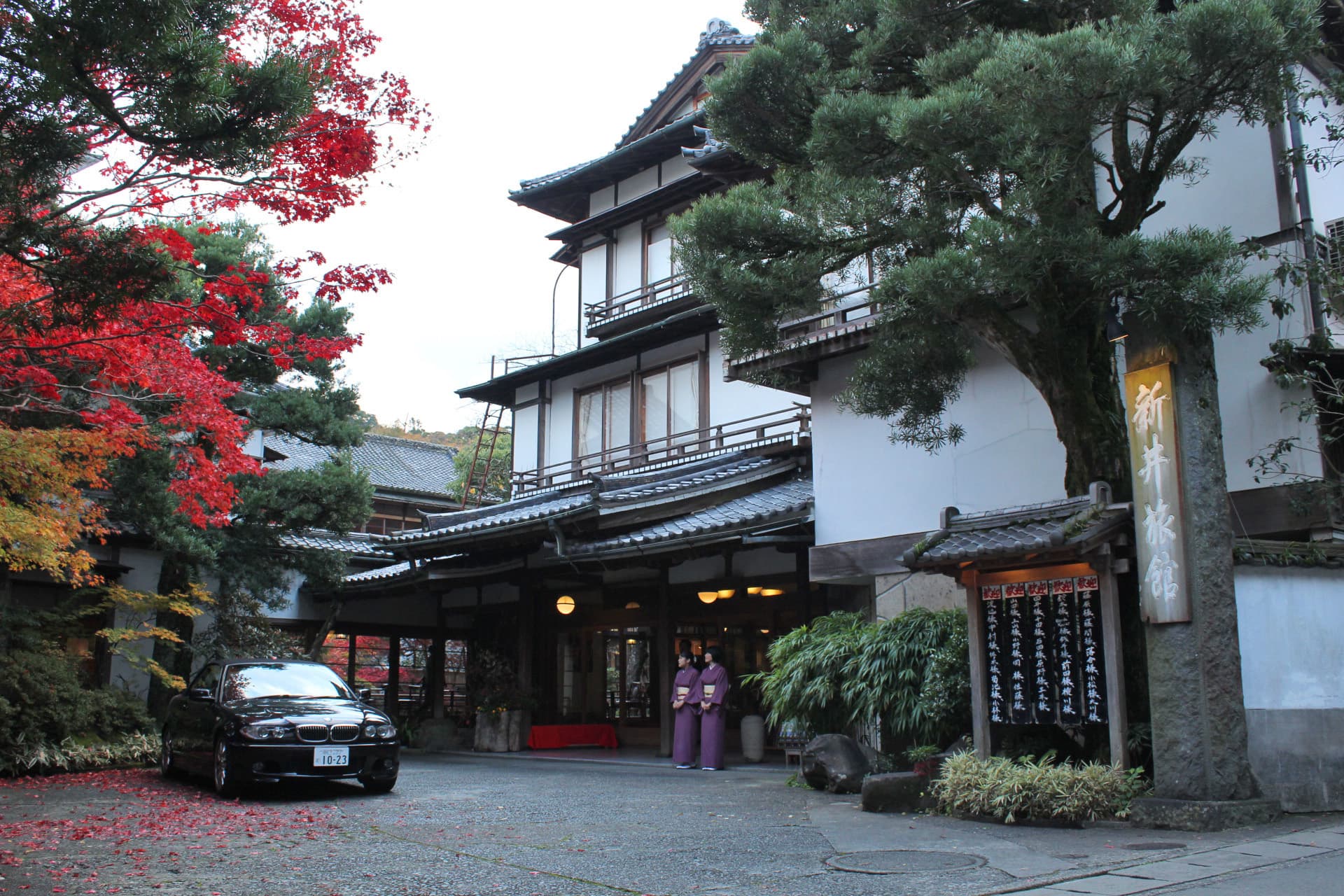
Arai Ryokan in Shuzenji asks guests with tattoos not to use the large baths — which means missing its famous 1934 hinoki Tenpyo bathhall. The alternatives the inn names are the free private bath Hisui, the bookable Suiren and the in-room baths. Many rooms have their own onsen bath, including the semi-special rooms by the carp pond; a 2025 guest on the cheapest 'leave it to us' plan was given a Yuki-wing room with one, but book the room type if it matters. There are steps or stairs everywhere and no lift.
Okutsuso in northern Okayama doesn't ban tattoos outright, but refuses tattoos 'that might frighten other guests' in its shared baths — including the Kagiyu, where the spring bubbles up through a granite riverbed floor. Its two private baths, Kawa-no-yu and Izumi-no-yu, are free, open 24 hours and need no booking — you just lock the door. The detached annex rooms Seikantei and Chōsentei also have their own free-flowing open-air bath on a deck, roofless and without a shower. Prices have risen sharply, and a car is close to essential.
 Area photo
IzuPremium
Izu-Nagaoka Onsen, Izunokuni, Shizuoka — a 1929 Mitsubishi family villa set in a 3,000-tsubo garden, reached by the inn's free shuttle from Izu-Nagaoka Station
9 sources
Sanyoso
伊豆長岡温泉 三養荘
A Mitsubishi family villa with a garden by Ogawa Jihei and a wing by Togo Murano, where every room has its own onsen bath — superb for architecture and gardens, less so for anyone who minds long corridors or wants a showpiece dinner
- Historic Ryokan
- Private Onsen Rooms
Area photoIzuClassic
Inatori Onsen, Higashi-Izu, Shizuoka — a 10-storey oceanfront ryokan about 5 minutes by free shuttle from Izu-Inatori Station on the east coast of the Izu Peninsula
9 sources
Inatori Ginsuiso
稲取銀水荘
The big Izu ocean-view ryokan once voted No. 1 for hospitality 15 years running: simmered kinmedai, an all-day free lounge and suites with their own spring-fed open-air baths — but unrenovated rooms, recurring corridor smells and a dated main bath drag it down
Read the Consensus Area photo
YugawaraClassic
Oku-Yugawara, Yugawara, Kanagawa — at the end of the bus line about 20 minutes from JR Yugawara station, in a ravine below the Hakone outer rim
10 sources
Oku-Yugawara Tsubaki
奥湯河原 海石榴
A sukiya-style inn at the end of the Oku-Yugawara bus line, with in-room meals, a prize-winning five-room guest house and a much-praised breakfast — but its onsen is recirculated and the standard rooms' baths aren't onsen at all
- Private Onsen Rooms
- Design-Led

Arima OnsenPremium
Arima Onsen, Kita-ku, Kobe, Hyogo — a 5-minute walk from Arima Onsen station, 2 minutes from the Hankyu bus stop
10 sources
Nakanobo Zuien
中の坊瑞苑
Arima's big classic inn: rust-red kinsen in the large baths, a shogi-title venue with a garden lobby — book a kinsen room by phone and you'll see why regulars keep coming back
- Private Onsen Rooms
- Historic Ryokan
 Area photo
Gero OnsenClassic
Gero Onsen, Gifu — a 264-room ryokan on the Hida river, three minutes' walk from JR Gero Station
9 sources
Gero Onsen Suimeikan
下呂温泉 水明館
Gero's grand ryokan since 1932: four wings, three big baths of silky alkaline water and Hida beef everywhere — choose the Rinsenkaku wing for onsen in your room, and expect crowds and tired rooms elsewhere
- Historic Ryokan

Gero OnsenClassic
Gero Onsen, Gifu — on the wooded hillside above the town, with a free shuttle from JR Gero Station
13 sources
Yunoshimakan
下呂温泉 湯之島館
A 1931 wooden resort inn that hosted two emperors — red-carpeted corridors, a Showa-era bar and Hida beef at 4.9 — but also a maze of stairs and a persistent musty smell
- Historic Ryokan
Area photoGero OnsenClassic
Yunoshima, Gero, Gifu — on the Hida River beside the JR Takayama Line bridge, about 15 minutes' walk from Gero Station (free shuttle) and about 10 minutes on foot from the centre of the onsen town
10 sources
Gero Onsen Bosenkan
下呂温泉 望川館
A friendly, family-minded Gero inn founded in 1818, with a 1,100-tsubo garden, a big riverside open-air bath, Hida beef hoba-miso dinners in private rooms and trains rumbling over the bridge outside — but the building is old, the baths are partly recirculated and down a steep flight of stairs
- Historic Ryokan
IzuClassic
Shuzenji Onsen, Izu, Shizuoka — in the centre of the old spa town, beside the Katsura River
9 sources
Arai Ryokan
修善寺温泉 新井旅館
Fifteen registered-heritage buildings around a carp pond and a 1934 hinoki bathhall designed by a painter — lovely, if you can manage the stairs and a cold winter corridor
- Historic Ryokan
- Private Onsen Rooms

Okutsu OnsenPremium
Okutsu Onsen, Kagamino, Okayama — a 1927 inn on the Yoshii river in the hills of northern Okayama, about 100 minutes by car from Okayama Station
9 sources
Okutsuso
名泉鍵湯 奥津荘
The 'locked bath' where alkaline water bubbles up through the granite riverbed beneath you — a registered-heritage inn of just ten rooms, with a new modern kitchen and prices that have climbed fast
- Historic Ryokan
- Private Onsen Rooms
How to ask before you book
Since most inns publish no policy, and some publish it in only one language — Hatcho no Yu's appears on its English page but not its Japanese ones — ask in writing before you book and keep the reply. Say where the tattoo is and roughly how big: a small mark, palm-sized, a sleeve, a back piece. Size is often where the line falls; Gora Kadan and Naraya accept small covered tattoos, Yorozuya about palm-sized ones. Ask whether cover stickers are accepted, how many and what size, and whether the inn sells them, because some inns refuse stickers and paint too. If the answer is no, ask which room types have their own onsen bath — not just 'a bath', since at Oku-Yugawara Tsubaki, Nakanobo Zuien and Inatori Ginsuiso some in-room baths are plain water — and whether guests with tattoos may use the private baths, and if they need booking. Finally, check which baths a rule covers: at HOSHINOYA Karuizawa the public spa and the guests-only bath follow different rules, and in Kinosaki the town's tourism body says all seven public bathhouses accept tattoos of any size without covering, though Mikiya states no policy for its own baths.
Photo credits
- Gōra Park, Hakone · Daderot / CC0
- The upper Kinu river near Kawamata Onsen, downstream of Okukinu (Nikko, Tochigi) · 690 Noda / CC BY 3.0
- Gora Kadan — the former Kan'in-no-miya imperial villa, Hakone · 663highland / CC BY 2.5
- Naraya — the entrance, Kusatsu Onsen · Abasaa / Public domain
- Yudanaka Onsen town, Yamanouchi, Nagano · くろふね / CC BY 3.0
- Kumoba Pond in autumn, Karuizawa, Nagano · Hiroaki Kaneko / CC BY-SA 3.0
- Shuzenji Onsen, Izu · 663highland / CC BY-SA 4.0
- The Fujiki river through Yugawara Onsen, Kanagawa · Quercus acuta / CC BY-SA 4.0
- Nakanobō Zuien — the entrance and main building, Arima Onsen · Abasaa / Public domain
- Gero Onsen and the Hida River, Gifu · Asturio Cantabrio / CC BY-SA 4.0
- Yunoshimakan — the registered-heritage main building, Gero · 大野 一将 / CC BY-SA 4.0
- Arai Ryokan — the entrance, Shuzenji · Batholith / Public domain
- Okutsuso — the Tōwarō building, Okutsu Onsen · Phronimoi / CC BY-SA 3.0