Ryokan easy from Tokyo: the best onsen inns within two to three hours
Twelve real ryokan you can reach from Tokyo for one or two nights, with how to get there by Romancecar, Odoriko, Shinkansen or direct bus, which inn suits a tight budget, a private bath, history or food, and the catches Japanese guests report.
Updated Oct 8, 2026
You don't need to cross Japan to stay at a proper ryokan. Hakone, Yugawara and the Izu Peninsula lie south-west of Tokyo along the Odakyu and Tōkaidō lines; Echigo-Yuzawa, Minakami and Karuizawa are a single Shinkansen ride north; and Gunma's old spa towns and the valleys behind Nikko are reached by direct bus or limited express. Pick well and you can leave Tokyo after lunch, be in the bath before dinner and be back the next afternoon.
Below are twelve inns from our directory whose reports give clear directions from Tokyo or from the nearest station, grouped by direction. Where a report gives a travel time we quote it; where it doesn't, we describe the route only as far as the report does — check the timetable before you book. The last stretch is often the catch: a shuttle you have to reserve, a bus that runs a few times a day, or a taxi from an unstaffed station. Everything here comes from our full report on each ryokan.
Hakone and Yugawara — the classic short hop
Hakone is the default first ryokan trip from Tokyo for good reason: the Odakyu Romancecar runs from Shinjuku to Hakone-Yumoto in about 90 minutes, and the Hakone Tozan Railway climbs on into the mountains. Yugawara, on the coast just south, is reached from JR Yugawara Station by bus.
Gora Kadan, the former summer villa of Imperial Prince Kan'in, is the luxury pick and the inn with the clearest directions: Romancecar to Hakone-Yumoto, then about 40 minutes up the Tozan Railway to Gora, where the inn's free car meets you. It holds three Michelin Keys and its spring comes from three sources the inn owns, but the reputation rests on the top tiers; 2026 reviews of the standard rooms are noticeably more mixed, and the shared indoor bath has water added.
Fukuzumiro, in Tonosawa, is about 15 minutes' walk from Hakone-Yumoto Station (or a short ride on the inn's shuttle), so it suits anyone who wants history without a long transfer. It's a registered-heritage wooden inn of 1890 where Natsume Soseki and Yasunari Kawabata stayed, with in-room kaiseki, a round red-pine tub about two metres across, free private baths and a stated policy of no tattoo restrictions. The trade-off is a museum-piece building: only one room has its own bath and toilet, the shared toilets aren't separated by gender, there's no lift, and winter is draughty.
Yugawara Onsen Gensen Uenoya is about 12 minutes by bus (stop 2 at Yugawara Station to Onsenba-chūō) or 10 minutes by taxi from the station. It calls itself Yugawara's oldest inn, its three wooden buildings are registered cultural properties, and every bath is filled from its own 82°C well with no recirculation or chlorine, including two free private open-air tubs. It is also one of the better-value stays here — most 2026 guests paid about ¥19,000–25,000 per person with two meals — but there's no lift, sound carries through the walls, dinners are deliberately small and cards are limited, so bring cash.

HakonePremium
Gora, Hakone, Kanagawa
11 sources
Gora Kadan
強羅花壇
A former imperial villa, Michelin three-key rated, with spring-fed baths and famously attentive staff — superb in the top tiers, but 2026 reviews are more uneven in the standard rooms
- Private Onsen Rooms
- Historic Ryokan
 Area photo
HakoneClassic
Tonosawa, Hakone, Kanagawa — on the Hayakawa River, about 15 minutes' walk from Hakone-Yumoto Station
10 sources
Fukuzumiro
塔之沢温泉 福住楼
A Meiji-era wooden inn where Soseki and Kawabata stayed — in-room kaiseki, a giant round pine bath, no tattoo rules, and shared toilets down the corridor
- Historic Ryokan
- Tattoo-Friendly
 Area photo
YugawaraClassic
Miyakami, Yugawara, Kanagawa — in the old hot-spring quarter, 50 m from the Onsenba-chūō bus stop, about 12 minutes by bus or 10 minutes by taxi from JR Yugawara Station
9 sources
Yugawara Onsen Gensen Uenoya
湯河原温泉 源泉 上野屋
Yugawara's oldest inn: three registered-heritage wooden buildings, its own 82°C spring poured unrecirculated into every bath and two free private open-air tubs — but no lift, steep stairs, thin walls and modest dinners
- Historic Ryokan
- Private Onsen Rooms
Izu Peninsula — Shuzenji, Izu-Nagaoka and the east coast
Izu takes a little longer than Hakone but rewards it with gardens, old spa towns and the sea. The Odoriko limited express runs from Tokyo Station to Shuzenji, the end of the line, in a little under two hours; Izu-Nagaoka is on the same line, and Inatori is on the east coast.
Asaba, in Shuzenji, was founded in 1484, holds three Michelin Keys and looks across its pond to a real working Noh stage, which guests call the most memorable part of the stay; every room has its own source-fed bath. From Shuzenji Station it's about a seven-minute taxi ride, with no shuttle. The catch is service that several detailed reviews describe as less polished than the reputation, and Noh performances are a ticketed seasonal programme, not nightly.
Sanyoso, at Izu-Nagaoka Onsen, is a 1929 Mitsubishi family villa with a garden by Ogawa Jihei and a 1988 wing by Togo Murano, reached by a free shuttle from Izu-Nagaoka Station that you book ahead. All 22 rooms have their own onsen bath, which also solves the tattoo question, since the public baths refuse tattoos. Come for architecture and the garden, not for dinner: meals are its weakest score, and the walk from some rooms to the baths and dining room is long.
Inatori Ginsuiso is the family-friendly ocean-view option on the east coast, about five minutes by free shuttle from Izu-Inatori Station (13:00–19:00). Guests praise warm staff, an all-day lounge with free drinks and kinmedai simmered in a long-kept broth, and 17 renovated suites have a free-flowing open-air bath. Standard rooms are unrenovated, the main bath is part-recirculated and chlorinated, and many 2025–2026 reviews mention a musty or sewage-like smell in the lobby and some corridors.
 Area photo
IzuLuxury
Shuzenji, Izu City, Shizuoka
13 sources
Asaba
あさば
A 540-year-old ryokan with a working Noh stage, and service that isn't always as polished as the history
- Private Onsen Rooms
- Historic Ryokan
Area photoIzuPremium
Izu-Nagaoka Onsen, Izunokuni, Shizuoka — a 1929 Mitsubishi family villa set in a 3,000-tsubo garden, reached by the inn's free shuttle from Izu-Nagaoka Station
9 sources
Sanyoso
伊豆長岡温泉 三養荘
A Mitsubishi family villa with a garden by Ogawa Jihei and a wing by Togo Murano, where every room has its own onsen bath — superb for architecture and gardens, less so for anyone who minds long corridors or wants a showpiece dinner
- Historic Ryokan
- Private Onsen Rooms
Area photoIzuClassic
Inatori Onsen, Higashi-Izu, Shizuoka — a 10-storey oceanfront ryokan about 5 minutes by free shuttle from Izu-Inatori Station on the east coast of the Izu Peninsula
9 sources
Inatori Ginsuiso
稲取銀水荘
The big Izu ocean-view ryokan once voted No. 1 for hospitality 15 years running: simmered kinmedai, an all-day free lounge and suites with their own spring-fed open-air baths — but unrenovated rooms, recurring corridor smells and a dated main bath drag it down
Read the ConsensusNorth by Shinkansen: Echigo-Yuzawa, Minakami and Karuizawa
The Shinkansen makes the mountains north and north-west of Tokyo surprisingly close. These three inns suit travellers who want the fastest door-to-bath time, or who want snow in winter.
HATAGO Isen is the quickest real ryokan stay in this guide: one minute's walk from the west exit of Echigo-Yuzawa Station, about 70 minutes from Tokyo by Joetsu Shinkansen. It's a barefoot inn of 16 rooms — six with their own free-flowing outdoor bath — and dinner in its restaurant ends with Uonuma Koshihikari rice cooked in a clay pot. Food and rooms score well; service is the consistent weak point since self check-in arrived, and the shared bath is a small indoor one with few washing stations.
Takaragawa Onsen Osenkaku is the bucket-list bath and the budget pick, with standard plans from around ¥17,000–19,000 per person. Its four riverside open-air baths add up to 470 tatami of free-flowing water, three of them mixed but with a bathing robe required, and one for women only. The inn's free shuttle runs about 40 minutes from Jomo-Kogen Shinkansen station or from JR Minakami Station — reserve early, as it runs only at set times. Expect an old building, day visitors until about 16:00, horseflies in summer and cold walks between baths in winter.
HOSHINOYA Karuizawa is 80 minutes from Tokyo by Hokuriku Shinkansen, then a free, reservation-only shuttle from Naka-Karuizawa Station (earlier guests were collected at Karuizawa Station, so check when booking). It's a car-free village of 77 rooms with no TVs and a guests-only Meditation Bath, and Japanese reviewers praise the stillness. It's more resort than traditional inn, rooms are sold without meals by default, and value is the recurring complaint; one-night stays open only 30 days ahead.
 Area photo
Echigo-Yuzawa OnsenClassic
Echigo-Yuzawa, Niigata — one minute's walk from the west exit of Echigo-Yuzawa Station, about 70 minutes from Tokyo by Joetsu Shinkansen
9 sources
HATAGO Isen
越後湯澤 HATAGO井仙
A barefoot, 16-room station inn with free-flowing baths, clay-pot Uonuma Koshihikari and a 'village feast' restaurant — 70 minutes from Tokyo, strong on food and rooms, weak on service
- Easy From Tokyo

MinakamiValue
Fujiwara, Minakami, Gunma — a lone inn on the Takaragawa stream at the top of the Tone River valley, about 40 minutes by the inn's shuttle from Jomo-Kogen shinkansen station
9 sources
Takaragawa Onsen Osenkaku
宝川温泉 汪泉閣
470 tatami of riverside open-air baths, where everyone wears the inn's bathing robe — Japan's most spectacular mixed bathing at a bargain price, if you can live with an old building, day-trip crowds and summer horseflies
- Secluded Retreats
 Area photo
KaruizawaLuxury
Hoshino, Karuizawa, Nagano — a gated 'valley village' of 77 rooms beside the Hoshino area, about 80 minutes from Tokyo by shinkansen plus a short shuttle
9 sources
HOSHINOYA Karuizawa
星のや軽井沢
Hoshino Resorts' flagship: a car-free village of rooms around a river, with no TVs, a light-and-dark Meditation Bath and seasonal Shinshu kaiseki — deeply restful, but meals cost extra and value is the sore point
- Design-Led
- Easy From Tokyo
Gunma's spa towns by direct bus — Ikaho and Shima
Two of Gunma's most historic onsen towns can be reached without changing trains: highway buses run from Shinjuku to Ikaho and from Tokyo Station to Shima, which makes them easy for anyone with luggage.
Chigira Jinsentei stands halfway up Ikaho's famous stone steps and is about 2h40 by highway bus from Shinjuku (or about 30 minutes by bus from JR Shibukawa Station), then about five minutes on foot. It's the place for bath-lovers on a mid-range budget: the brown 'golden' kogane-no-yu is described by the inn as 100% free-flowing, and four private baths are free with no booking. The food divides opinion, the building is a maze of stairs where sound carries, and the private baths are hard to get in the evening.
Shima Tamura, founded in 1563, is reached by direct bus from Tokyo Station or about 40 minutes by bus from JR Nakanojō Station, with no station shuttle. It has seven free-flowing baths from its own riverbed sources, including a pebble-floored bath where the spring rises from below and a mixed bath dug into the riverbed, and kaiseki plans start around ¥19,600 per person. In return you get an ageing, confusing building full of steps, and cleanliness is its weakest score in 2026 reviews.

Ikaho OnsenClassic
Ikaho Onsen, Shibukawa, Gunma — halfway up the Ishidan stone steps
9 sources
Chigira Jinsentei
伊香保温泉 千明仁泉亭
Ikaho's oldest inn on the stone steps, with free, unbookable private baths of rust-gold water — a bath-lover's favourite whose food divides opinion
- Historic Ryokan
- Private Onsen Rooms
 Area photo
Shima OnsenClassic
Shima Onsen, Nakanojō, Gunma — beside the Shinyu river at the heart of the onsen village, about 40 minutes by bus from JR Nakanojō Station or by direct bus from Tokyo Station
9 sources
Shima Tamura
四万たむら
A bath-keeper's inn since 1563 with seven free-flowing baths from its own riverbed sources — a mixed bath in the river, a waterfall-view open-air bath, a pebble-floored bath where the spring rises underfoot — in a big, ageing, maze-like building
- Historic Ryokan
Nikko's back valleys — Yunishigawa
Beyond Nikko and Kinugawa, the mountain villages are quieter, but the last leg needs planning: buses are infrequent and inns rarely collect you.
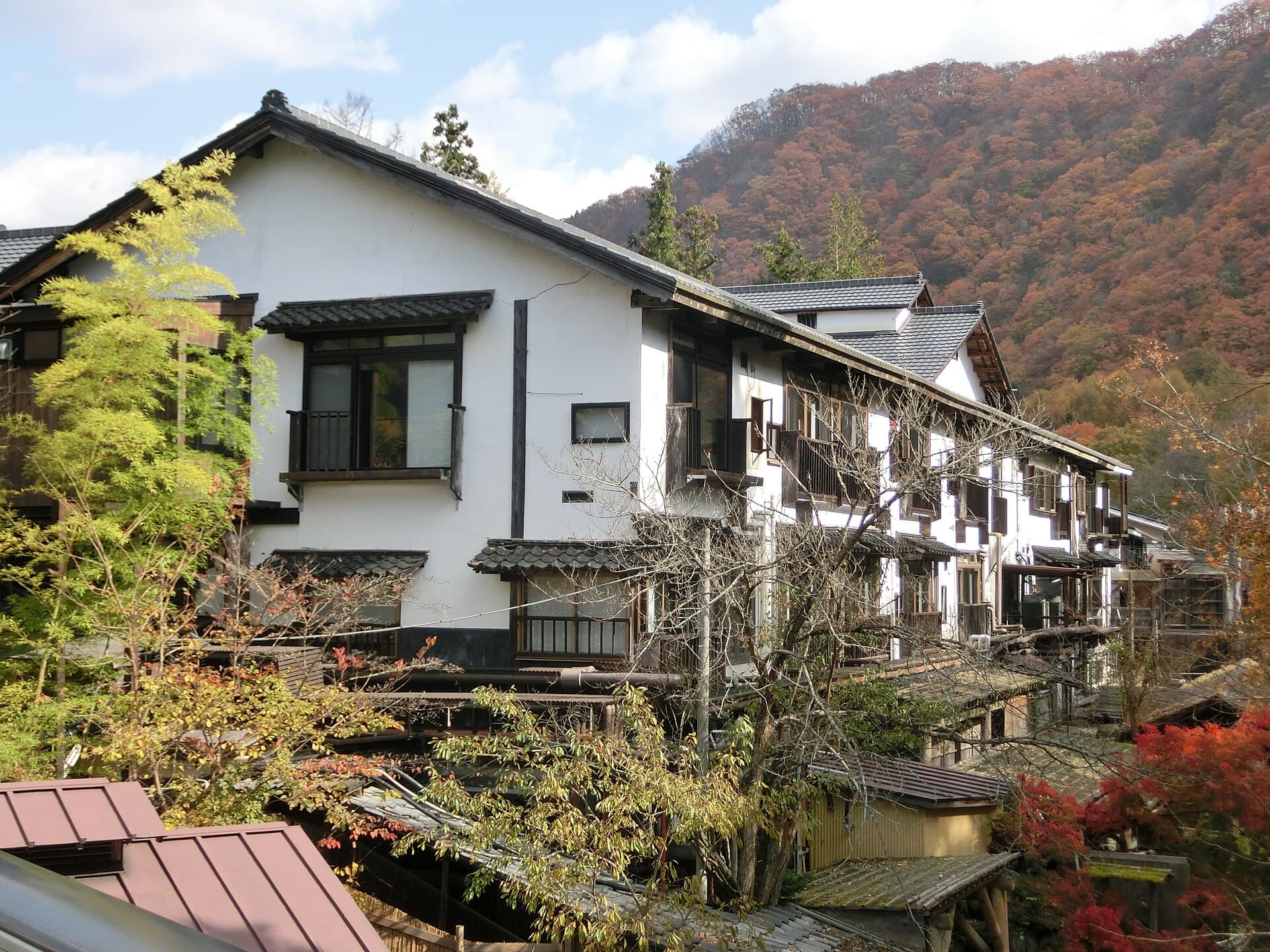
Honke Bankyu, in the Heike-legend village of Yunishigawa, is the food choice of this guide: guests cross a swaying vine bridge to private irori rooms for venison skewers and salt-grilled iwana, and dinner scores highest on the major booking site. There is no pickup; buses run from Yunishigawa Onsen Station, and the last one (17:15) connects with the 14:30 limited express from Asakusa, so leaving Tokyo later than that won't work. Expect thin walls, no lift, plenty of steps and some debate about how much of the water is free-flowing.
Which one for you?
Shortest journey: HATAGO Isen (about 70 minutes, a minute from the platform), or Fukuzumiro and Gora Kadan via the Romancecar. On a budget: Takaragawa Onsen Osenkaku, Yugawara Onsen Gensen Uenoya, Shima Tamura or Chigira Jinsentei. A private bath in every room: Asaba and Sanyoso. History you can feel: Fukuzumiro, Uenoya, Shima Tamura and Asaba. Food first: Honke Bankyu and HATAGO Isen. Free-flowing water as the point of the trip: Takaragawa, Uenoya, Shima Tamura and Chigira Jinsentei.
Two practical tips. Book any station shuttle when you book the room — several here run only at set times or must be reserved in advance. And plan to arrive by mid-afternoon: check-in is usually 14:00–15:00, dinner is fixed, and the last shuttle or bus can leave as early as mid-afternoon.
Photo credits
- Gora Kadan — the former Kan'in-no-miya imperial villa, Hakone · 663highland / CC BY 2.5
- Gōra Park, Hakone · Daderot / CC0
- The Fujiki river through Yugawara Onsen, Kanagawa · Quercus acuta / CC BY-SA 4.0
- Shuzenji Onsen, Izu · 663highland / CC BY-SA 4.0
- Entrance to Echigo-Yuzawa Onsen, Niigata · Abasaa / Public domain
- Takaragawa Onsen Osenkaku in winter, Minakami · kallerna / CC BY-SA 3.0
- Kumoba Pond in autumn, Karuizawa, Nagano · Hiroaki Kaneko / CC BY-SA 3.0
- Chigira Jinsentei — the entrance, Ikaho Onsen · Qurren / CC BY-SA 4.0
- The Shima River at Shima Onsen, Gunma · Kentaro Ohno / CC BY 2.0
- Honke Bankyu in autumn, Yunishigawa Onsen · Abasaa / Public domain