Mixed bathing at a ryokan — how konyoku works, and ten inns that still have it
How mixed-gender bathing (konyoku) works at a Japanese inn — robes, wraps, towels and women-only hours — and ten reviewed ryokan with a mixed bath today, each inn's rule exactly as it states it, compared honestly.
Updated Oct 12, 2026
Konyoku (混浴), mixed-gender bathing, survives mostly at old mountain and riverside inns, and the rules differ completely from one to the next. At some, everyone must wear the inn's own bathing garment; at others, a towel or bathing wrap is allowed; at a few, the traditional rule holds and nothing may be worn in the water. Some set aside women-only hours in the mixed bath, some don't, and several inns have changed their rules in the past few years — one split its famous mixed bath into men's and women's sides, another now requires swimsuits.
Below are the ten inns in our directory whose reports say a mixed bath is in use today, grouped by what you may wear: three where everyone wears a robe, wrap or towel, four where wraps or towels are allowed, and three under the older rules or where the rule isn't stated. For each we give the inn's stated rule, its women-only times and the catches guests report. Schedules shift — two of these inns have published conflicting hours — so check the board at check-in, and confirm directly with the inn if a rule decides your booking.
How mixed bathing works
Changing rooms are usually separate, even when the bath itself is shared: you undress on your own side and walk or step into the common water. Many inns that have a mixed bath also keep separate men's and women's baths, and some add private baths, so nobody has to use the mixed one.
What you may wear is the inn's rule, not yours. In our directory there are three patterns: a garment the inn provides and requires (at Takaragawa Osenkaku your own garment or swimsuit isn't allowed); a towel or bathing wrap you may wear if you choose; and the traditional rule, where wraps and towels are not allowed in the water. A women-only hour, where it exists, means the mixed bath is reserved for women for that slot; it is a policy, so read the posted times rather than relying on older blogs.
The etiquette is the same as in any onsen, with a few points that matter more here. Wash before you get in where there are taps — some riverside baths have none, so wash in the indoor bath first. Don't photograph: several of these inns ban it outright. Give other bathers space and don't stare or linger, and respect women-only times strictly. Unless the inn's rule says wraps or towels are worn in the water, keep your small towel out of it.
Everyone covered: robes, wraps or towels for all
At these three inns the cover rule applies to every bather, which makes them the easiest introduction to mixed bathing.
Takaragawa Osenkaku in Minakami, Gunma, has four enormous open-air baths along the Takaragawa stream, 470 tatami in all, filled with free-flowing water from four wells on site. Three are mixed — Maka-no-yu, Hannya-no-yu and Kodakara-no-yu, the largest — and Maya-no-yu is for women only. Since April 2019 everyone in the mixed baths must wear the inn's bathing garment, a dress-style robe for women and a waist wrap for men; your own garment or swimsuit isn't allowed, and photography is banned. The robes are sized for women but one-size for men, and the men's wrap can gape. Staying guests bathe 14:00–24:00 and 5:00–9:30, and day visitors share the baths until about 16:00. There are no washing areas by the river, some pools run cool in late autumn and winter, horseflies bite in summer, and two-meal plans start around ¥17,000–19,000 per person.
Sansuikan Kawayu Midoriya, at Kawayu in Kumano, has an open-air bath on the Ōtō River gravel, fed by the inn's own 70°C spring and kept for its guests (5:00–24:00, closed 10:00–14:00). It is mixed, everyone wears the bathing wraps provided, and there are two pools loosely split by sex; in summer you can wade from the bath into the river. The catches: an August 2026 guest found it hard to relax when others came close, the men's wrap slipped off, bad weather can close the bath, and 2026 reviews flag tired rooms and patchy cleaning. In winter the free village river bath, Sennin-buro, is a 7-minute walk away. Two-meal stays ran about ¥12,000–24,000 per person in summer 2026.
Shiobara Onsen Yumori Tanakaya in Tochigi keeps its riverside baths roughly 300 steps below the road. There, Sengō-yu is mixed and Bijin-yu is women-only, and everyone of primary-school age or older must wear a bath towel (free to rent), a bathing wrap or a swimsuit. Two other mixed pools, Kawara-no-yu and Iwama-no-yu, are closed from 10 February 2026 until about February 2028 because of dam discharge upstream. The climb back is hard — several older guests in 2026 turned back — but the top-floor baths are separate for men and women, and ten rooms have their own free-flowing tub. The inn refuses guests with tattoos, including stickers. Two-meal stays cost about ¥16,000–30,000+ per person.

MinakamiValue
Fujiwara, Minakami, Gunma — a lone inn on the Takaragawa stream at the top of the Tone River valley, about 40 minutes by the inn's shuttle from Jomo-Kogen shinkansen station
9 sources
Takaragawa Onsen Osenkaku
宝川温泉 汪泉閣
470 tatami of riverside open-air baths, where everyone wears the inn's bathing robe — Japan's most spectacular mixed bathing at a bargain price, if you can live with an old building, day-trip crowds and summer horseflies
- Secluded Retreats
 Area photo
Kawayu Onsen (Kumano)Value
Kawayu Onsen, Hongū, Tanabe, Wakayama — on the Ōtō River, 10 minutes by car from Kumano Hongū Taisha and a 2-minute walk from the Kawayu Onsen bus stop (about 50 minutes by bus from JR Shingū, 2 hours from JR Kii-Tanabe)
10 sources
Sansuikan Kawayu Midoriya
山水館 川湯みどりや
A big, good-value Kumano Kodo base whose river-level open-air bath you share in a bathing wrap, with all-you-can-drink beer and sake and unlimited grilled ayu at dinner — but the bath is mixed, and 2026 reviews flag tired rooms and patchy cleaning
Read the Consensus Area photo
NasushiobaraClassic
Ōami, at the entrance to Shiobara Onsen, Nasushiobara, Tochigi — above the Hōki River gorge on the old Route 400, right by the Shiobara-Ōami bus stop (53 minutes by JR bus from Nasu-Shiobara Station) and about 15 minutes by car from Nishinasuno-Shiobara IC
10 sources
Shiobara Onsen Yumori Tanakaya
塩原温泉 湯守田中屋
A family-run gorge-side inn at the gateway to Shiobara, loved for charcoal irori dinners, warm service and free-flowing water in every bath — but the famous riverside baths sit about 300 steps below, are mostly mixed-bathing, and two of the four are closed until about 2028
- Destination Dining
- Easy From Tokyo
Wraps or towels allowed
These four inns let you wear a towel or bathing wrap in the mixed bath, and three of them also set aside women-only time.
Hatcho no Yu, at about 1,300 m in Okukinu, beyond the end of the public road, has three mixed open-air baths by a waterfall — Yukimi-no-yu (the 1929 original), Takimi-no-yu and Shakunage-no-yu — plus Sawagani-no-yu, which alternates (women 10:00–21:00, men 22:00–10:00), and separate indoor baths. From 21:00 to 22:00 all the open-air baths are women only. Towel wrapping is allowed (a rental towel is ¥400 on the official site; avoid dark towels, which can lose colour), and bath wear is sold in the shop. Guests note the mixed baths can be seen from the walkway, and one 2026 complaint said a mixed bath had been turned into a men-only one. Since 2023 some log-cabin rooms have their own open-air bath, the inn's English page calls it tattoo friendly, and the baths have been for staying guests only since February 2025.
Taenoyu at Nyuto Onsen in Akita is the Nyuto inn reviewers recommend to first-timers. Its riverside mixed bath, Myoken-no-yu, beneath an artificial waterfall, allows towels and has a women-only hour for staying guests (reports say 17:00–18:00; one 2022 report says 16:00–17:00). Know that the water is see-through, the bath is barely lit at night, and day visitors describe it as effectively a men's bath. The free private bath, Yawaragi-no-yu, is the alternative — book it the moment you check in, as 30-minute slots go fast. The cheapest plans on one Japanese site were about ¥51,000 for two with two meals.
Yarimikan in Okuhida has two mixed riverside baths facing the Northern Alps: Yarimi-no-yu, with its view of Mount Yarigatake, which is women-only from 7:00 to 9:00, and Manten-no-yu, the oldest tub. Iwami-no-yu is a women-only open-air bath, and the indoor baths are separate. Bathing wraps are provided for women and, the English site says, for men on request — but men aren't required to wear them, and a 2026 guest noticed the women's changing area could be seen from the mixed bath. There's no washing area by the river. Four free private baths need no booking: you lock the door with a wooden tag. Standard rooms cost about ¥21,000–25,000 per person with two meals.
Awanoyu at Shirahone, Nagano, is built around one bath: a 70-tsubo outdoor pool of milky, sulphurous water at 37–38°C, warm enough to sit in for an hour. It's mixed with no women-only hours, but designed to be approachable: separate entrances, a women's changing room with about six slippery steps straight into the opaque water, and a thick towel-style wrap lent free to overnight guests (day visitors pay ¥800 for a towel). There are small separate outdoor baths for each sex, but no private bath. A December 2025 reviewer reported bathers loitering near the women's entrance and felt the front desk brushed it off. Children aged 12 and under are not accepted.
 Area photo
Okukinu OnsenValue
Okukinu Onsen, Kawamata, Nikko, Tochigi — at about 1,300 m in Nikko National Park, beyond the end of the public road; cars stop at the Meotobuchi car park and guests ride the inn's shuttle about 30 minutes up a dirt forest road (or hike about 1.5–2 hours)
9 sources
Hatcho no Yu
奥鬼怒温泉 八丁の湯
A 1929 mountain hut past the end of the road in Okukinu, with three free-flowing mixed open-air baths by a waterfall and newer log cabins — wonderful water, but basic rooms, no air conditioning and a shuttle you have to plan around
- Secluded Retreats
- Tattoo-Friendly
 Area photo
Nyuto OnsenClassic
Nyuto Onsen, Semboku, Akita — on the Sendatsu River in Towada-Hachimantai National Park
9 sources
Taenoyu
乳頭温泉郷 妙乃湯
Nyuto's gentler, more polished alternative — two different springs, a riverside mixed bath with women-only time, and warm service, though the rooms are small and the layout confusing
- Secluded Retreats
 Area photo
Okuhida OnsenClassic
Shinhotaka Onsen, Okuhida, Takayama, Gifu — alone on the Kamata River below the Northern Alps
10 sources
Yarimikan
槍見の湯 槍見舘
Riverside open-air baths facing the Northern Alps, four free private baths and Hida beef, in a 200-year-old farmhouse — rustic by design, with mixed bathing and a lot of steps
- Secluded Retreats
- Private Onsen Rooms

MatsumotoClassic
Shirahone Onsen, Matsumoto, Nagano — alone in a mountain valley on the way to Kamikochi
9 sources
Awanoyu
白骨温泉 泡の湯
A huge milky-blue mixed bath you can soak in for an hour — lukewarm by design, with bathing wraps for women — at a century-old mountain inn that's no longer for families
- Secluded Retreats
The traditional rules: nothing worn in the water
Two of these inns state that towels and bathing garments are not allowed in the mixed bath; for the third, our report doesn't say. These are some of Japan's most celebrated baths, but go in knowing the rule.
Hoshi Onsen Chojukan in Minakami is the only inn at Hoshi Onsen, and its 1895 wooden bathhall, Hoshi-no-yu, has the spring rising straight up through the pebbles under you. It is mixed except for women-only time from 20:00 to 22:00; changing rooms are separate and the hall is dim, but bathing garments and wrapped towels are not allowed, and there are no washing stations. Women always have a bath of their own: the cypress Tamaki-no-yu is theirs 15:00–20:00 and 7:00–10:00 on the inn's 2026 timetable, and Choju-no-yu alternates. The inn's pages disagree on hours and it issued a correction in September 2026, so check the posted schedule. Recent reviews say women's time is short and crowded, with reports of other bathers lingering or walking in during it. The inn now holds occasional women-only stay days, when all three baths are open to women at any time; the next is 16–17 December 2026. Prices in our sources ran ¥21,600–29,450 per person.
Tsurunoyu at Nyuto Onsen, the oldest of Nyuto's inns, has Japan's most photographed milky-blue mixed outdoor bath. It has no women-only hours and towels may not be worn; women enter from their own side, behind a screen, and the cloudy water hides the steps. There are women-only outdoor baths, a guests-only indoor bath and two private indoor baths, which get queues. Day visitors arrive from 10:00, so bathe in the evening or early morning; the outdoor bath is drained for cleaning on Mondays. Rooms start at about ¥11,700, and they fill months ahead.
Ryokan Ohnuma at Higashi-Naruko, Miyagi, has a large mixed bath, the Yakushi Sennin-buro under a mural of celestial maidens, with a women-only time slot — blogs reported 19:30–21:00, so check on arrival. Our report doesn't say whether towels or wraps may be worn there; ask the inn. Everyone else has plenty of choice: a women-only bath, Tennyo-buro, four free private baths that need no booking, and the paid hillside Mori-no-yu (¥1,650 per person for 30 minutes). Two-meal stays run about ¥10,700–19,600 per person.

MinakamiClassic
Hoshi Onsen, Minakami, Gunma — the only inn at the end of a mountain road
11 sources
Hoshi Onsen Chojukan
法師温泉 長寿館
A lone Meiji-era inn where the water bubbles up through the stones beneath you — one of Japan's great baths, if you can handle mixed bathing, no air conditioning and autumn stink bugs
- Historic Ryokan
- Secluded Retreats

Nyuto OnsenValue
Nyuto Onsen, Semboku, Akita — at the end of a forest road in Towada-Hachimantai National Park
10 sources
Tsurunoyu Onsen
乳頭温泉郷 鶴の湯温泉
Japan's most photographed milky mixed bath, a thatched samurai-guard house with irori hearths, and rooms from about ¥11,700 — rustic, cold in places, and hard to book
- Historic Ryokan
- Secluded Retreats
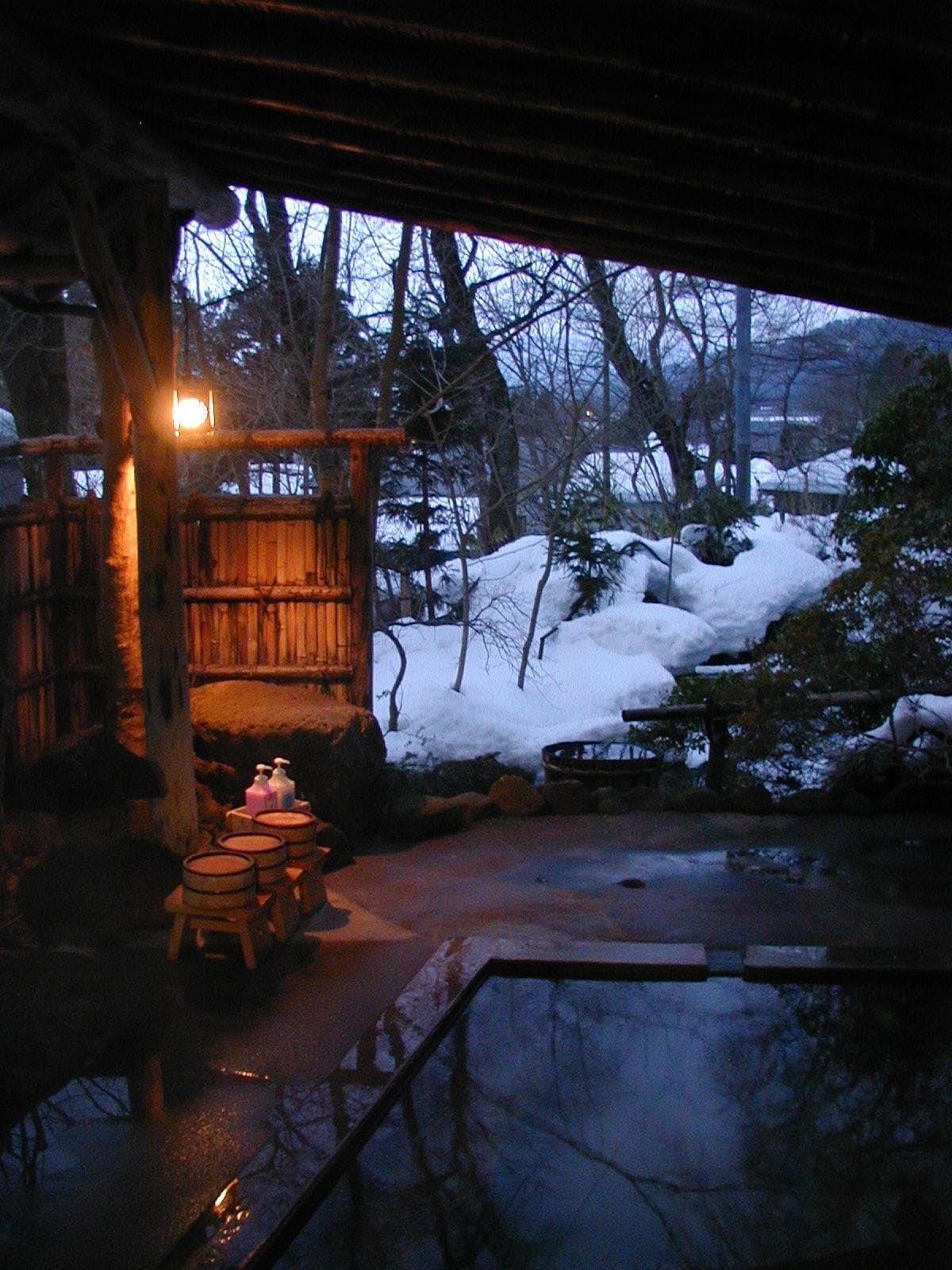
Naruko OnsenValue
Higashi-Naruko Onsen, Osaki, Miyagi — a century-old tōji inn five minutes' walk from JR Naruko-Gotenyu Station
9 sources
Ryokan Ohnuma
旅館大沼
Eight free-flowing baths of two baking-soda springs, four of them free private baths you just lock, a hillside garden bath and famous house natto — a modern tōji inn at old-fashioned prices, with stairs and shared toilets
- Historic Ryokan
Mixed baths that have changed
Older guidebooks and blogs list several inns as mixed that no longer are, or no longer in the same way. Takayu Onsen Adachiya's long open-air bath, Taiki-no-yu, was famous as a mixed bath; after a 2024–25 renovation it was split into east and west halves that swap between men and women overnight, so it's no longer mixed. At Tsuta Onsen, the old mixed bath Kyūan-no-yu now alternates between men and women. And at Ochiairo in Yugashima, since 13 September 2025 the Tengu-no-yu cave and open-air bath has been a mixed 'thermal spring' where swimsuits or bath wear are required — 2026 reviewers split between families who enjoyed bathing together and guests who found shared bath wear clingy or unsuited to Japanese bathing. If a mixed bath is the reason for your trip, check the inn's current page, not a blog from a few years ago.
Which one to choose
For a first time, an inn where everyone is covered is the gentlest start: Takaragawa Osenkaku for scale, Kawayu Midoriya for a river you can wade into. If you'd like a wrap but also want women-only time, Hatcho no Yu (21:00–22:00), Taenoyu (an hour for staying guests) and Yarimikan (7:00–9:00) fit; Awanoyu has the wrap and opaque water but no women-only hours. Hoshi Onsen Chojukan and Tsurunoyu are the bathing experiences people travel for, under the older rules — at Chojukan with a women-only window and women-only stay days, at Tsurunoyu with neither. And if you'd rather not bathe mixed at all, most of these inns give you another way: Yarimikan and Ohnuma have four free private baths each, Tsurunoyu two and Taenoyu one, while some of Hatcho no Yu's cabins, ten of Yumori Tanakaya's rooms and Kawayu Midoriya's suites have their own bath.
Photo credits
- Takaragawa Onsen Osenkaku in winter, Minakami · kallerna / CC BY-SA 3.0
- Kawayu Onsen on the Kumano Kodo, Wakayama · Nekosuki / CC BY-SA 4.0
- Autumn colours in Nasushiobara, Tochigi · Raita Futo / CC BY 2.0
- The upper Kinu river near Kawamata Onsen, downstream of Okukinu (Nikko, Tochigi) · 690 Noda / CC BY 3.0
- Autumn on the Sendatsu River, Nyuto Onsen, Akita · lumoplank / CC0
- The Kamata River near Shinhotaka Onsen, Okuhida, Gifu · Tmv / CC BY 4.0
- Awanoyu in its valley, Shirahone Onsen · YOSHIFUMI OGISO / CC BY-SA 3.0
- Hoshi Onsen Chojukan — the entrance in snow · veroyama / CC BY 2.0
- Tsurunoyu — the gate and thatched honjin, Nyuto Onsen · lumoplank / CC0
- An outdoor bath at Ryokan Onuma, Naruko Onsen · Jpatokal / CC BY-SA 3.0